Do numbers have definitions? We often think about what a word means. We are taught to use a dictionary look them up.
When have you last asked yourself what a number means? What is a number?
A number is also a word. 5 is also “five”.
Merriam website defines “five” as “a number that is one more than four.” We could also say that “five” written in number form as 5 is also “a number that is one more than four.”
What if we used imagery to define a word rather than words to define a word.
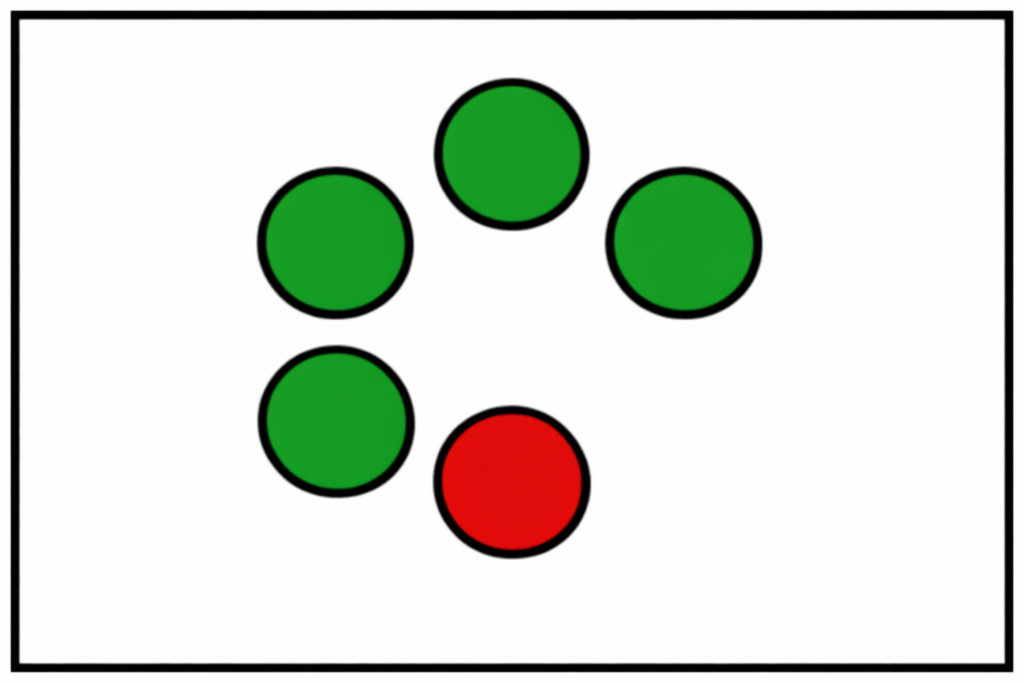
When we define 5 or “five” with an image, we imagine something like the image above. Which shows five circles, or four green plus one red circle.
While everyday words describe objects we’ve learned to remember, like table, chair, or car. Those same concepts can be referred to using other words like the ones in the following table.
| English Word | French Word | Spanish Word | German Word | Mandarin Word |
| Table | Table | Mesa | Tisch | 桌子 |
| Chair | Shez | Silla | Stuhl | 椅子 |
| Car | Voiture | Coche | Auto | 汽车 |
All of those words use different letters but the words in each row all mean the same thing. They are words from different languages, which is intuitive to most of us.
Math has a similar “languages,” also referred to as numbering systems.
| Decimal Number | Hexidecimal Number | Octal Number | Binary Number |
| 5 | 5 | 5 | 101 |
| 26 | 1A | 32 | 11010 |
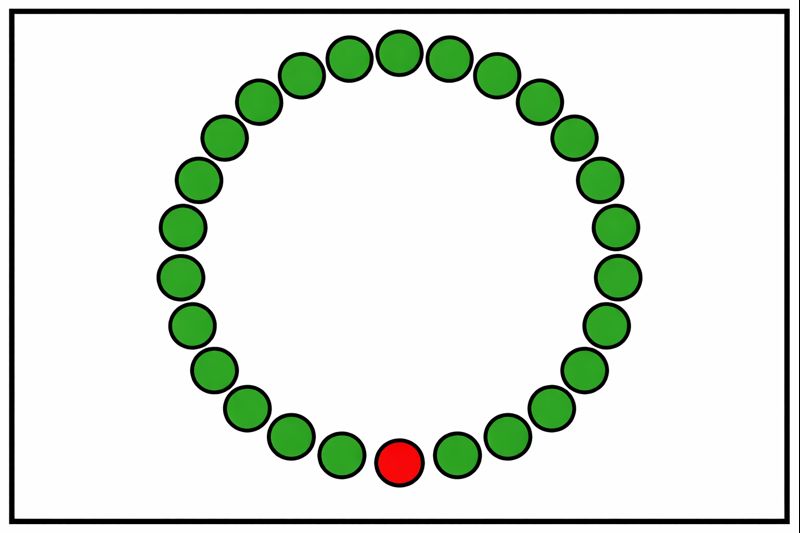
Depending on the numbering system you are using you can say:
- There are 26 circles
- There are 1A circles
- There are 32 circles
- There are 11010 circles
Something is missing because it’s ambiguous whether we have 32 circles or 26 circles. When we measure something with a ruler we usually refer to our measurements in units. For example, “the stick is 13 centimeters long” or “the stick is 13 inches long” in both cases the number is 13 but the unit “inches” or “centimeters” let’s you know how to interpret or decode the 13 in your mind.
We could change our description of the picture like this:
- There are 26 circles in decimal.
- There are 1A circles in hexidecimal.
- There are 32 circles in octal.
- There are 11010 circles in binary.
We can generalize that further if we want by referring to the number by their base. Number systems are anchored around a base number.
- There are 26 circles in base 10.
- There are 1A circles in base 16.
- There are 32 circles in base 8.
- There are 11010 circles in base 2.
The moral of the story is that all of these different words or numbers can mean the same thing. Numbers are language to help use describe the world.
If you want a better understanding of number systems check out this video at Khan Academy, you’ll need an understanding of exponents for this.
Leave a Reply